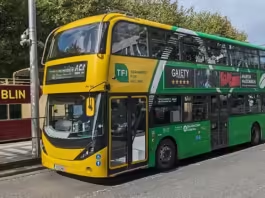
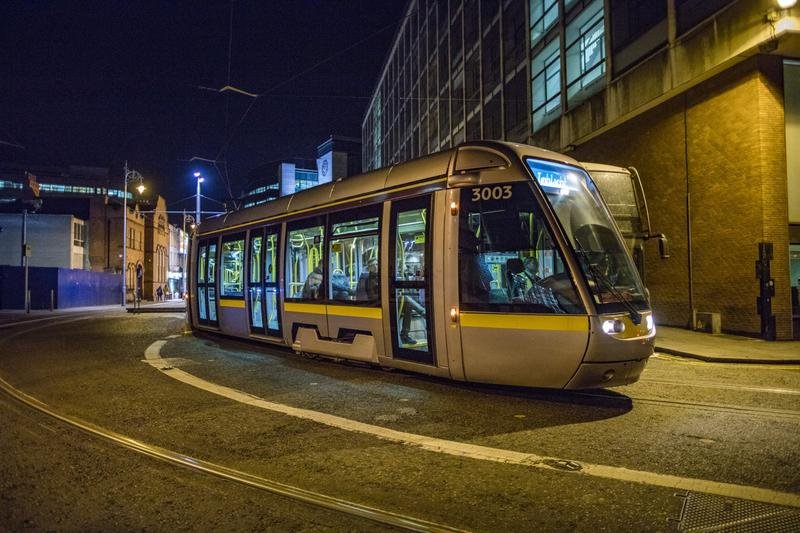
Dublin once had a wonderful network of trams. In the early 20th century, the Dublin United Tramways Company ran services over roughly 66 miles of track, carrying workers into and around the city every day. Dublin was a real pioneer in tram building back then. But as combustion engines improved, and public money ran short during Ireland’s early years of independence, the lines were gradually dug up. The last tram in Dublin City ran in July 1949.
Happily, that wasn’t the end of the story. The Luas, whose name means “speed” in Irish, arrived in 2004. Dublin’s population was growing and the city badly needed reliable public transport. Over two decades later, it has become one of the great success stories of Irish transport. It carried 55 million passenger journeys in 2025, and it’s now the busiest railway in the country.
Understanding the Routes
Luas runs on two lines, and both are easy to get the hang of.
The Green Line runs from Brides Glen in the south to Broombridge in the north. Along the way it passes through Dundrum, Ranelagh and St. Stephen’s Green, then crosses the city centre and carries on up towards Phibsborough. If you’re staying near Grafton Street or heading to the south side suburbs, this is probably your line.
The Red Line runs from Tallaght and Saggart in the southwest, through Heuston Station, along the Liffey past Smithfield and the Four Courts, and into the city centre. From there it goes on to The Point in the Docklands, with a branch to Connolly Station.
The two lines don’t physically cross, but they meet in the heart of the city. The Green Line stops around O’Connell Street and the Red Line stops on Abbey Street, only a short walk apart. Changing between them takes just a few minutes.
Practical Tips for Using the Luas
Tickets and Leap Cards. You can buy single and return tickets at the ticket machines at every stop, and the machines take cash, cards, Apple Pay and Google Pay. A TFI Leap Card is usually better value. Leap Cards are sold at shops that display the Leap sign, and you can top them up at any Luas machine, or by using the Leap Top-Up app on your phone.
Tap on, tap off. This is the one habit worth building. With a Leap Card you tap on at the platform validator before you board, and tap off when you get off. Skipping the tap-off can mean you’re charged a higher fare. If a ticket inspector asks and you don’t have a valid ticket or Leap Card, the fine is €100, reduced to €45 if you pay within 14 days. Inspectors do check, so it’s worth the two seconds.
Fares in a nutshell. Leap Card fares are a good deal. At the time of writing, an adult 90-minute fare is €2.00, with a €1.50 short fare for shorter hops. You can also change between Luas, Dublin Bus, DART and commuter rail within 90 minutes of your first tap at no extra cost. A daily cap also means you won’t spend more than a set amount in a day. Fares do change from time to time, so check luas.ie for the current prices.
Visiting Dublin? We recommend the Leap Visitor Card, which is designed for short stays and covers Luas, buses and DART. Details are on luas.ie.
Children and free travel. Children under 5 travel free, and Free Travel Pass holders can use Luas too.
What’s New on the Luas
A lot has happened since this guide was first written.
A new operator. Transdev had run Luas since it opened in 2004. From 1 September 2026, a new company, KeolisAmey, took over operating and maintaining the network under a contract worth around €1.3 billion. You may not notice much as a passenger, but it’s a big change behind the scenes. The contract also covers the next phase of Luas expansion.
Finglas is next. The Green Line is set to extend north from Broombridge. Luas Finglas received planning permission (a Railway Order) in October 2025 for a roughly 4km extension with four stops: St Helena’s, Finglas Village, St Margaret’s Road and Charlestown, near the M50. The journey from Charlestown to the city centre is expected to take around 30 minutes. The project is now waiting on funding before it moves to the next stage.
Lucan and Poolbeg. Both are still in the planning stage. Draft routes for Lucan are expected to go to public consultation by the end of 2026, with Poolbeg following in early 2027.
Luas Cork. It’s not Dublin, but it’s worth a mention. A preferred route for a Luas line in Cork, from Ballincollig to Mahon, was published for public consultation in 2026.
More trams on the way. The NTA has said it’s buying new trams to add capacity, which should be good news for anyone who’s squeezed onto a busy Green Line tram at rush hour.
See more on the DART rail network which you may also wish to use.